
In our latest Citizen Science Discoveries post, we turn to a topic that, perhaps surprisingly, is one we discuss regularly on our Zooniverse Talk – soldiers. The U.S. Navy and the Army may have a famed rivalry (especially on the football field!) but our Citizen Scientists frequently encounter references to soldiers on our Civil War naval musters. Community members such as @BlankAJ, @dona79, @KaiserSnowse and @SandyCycler are among those who have flagged these seemingly incongruous links to the Navy’s rival branch. We decided to take a look at some of these discoveries in an effort to learn just what these men were doing aboard Civil War U.S. Navy vessels- and what that might tell us about wider issues the Navy faced during the conflict.
The first type of reference to soldiers we are going to look at is also one of the most common on the muster sheets. This is where “soldier” was listed as a man’s occupation when they entered the Navy. Recently @KaiserSnowse spotted two examples of this on a 1 April 1865 muster from the schooner USS Adolph Hugel. There new sailors Gerhardus Rikkers from the Netherlands and Michael Waters from Co. Sligo in Ireland were both recorded in this fashion. Occasionally, entries like this can mean the man had been a “professional” soldier, serving in the regular military either in the United States or elsewhere. But in the majority of instances, and especially with late war naval recruits, it usually meant that the man in question had previously served in a volunteer infantry unit (or the Marines) during the Civil War. These men may have completed their service in the army, been discharged for disability, or even deserted before choosing to enter the Navy. Although difficult to track with certainty, both Gerhardus and Michael entered the maritime service in the final weeks of the Civil War, suggesting that their army experience may well have come in Union blue earlier in the conflict.

One of the other encounters our Citizen Scientists have been having with army men are those recorded as having transferred from that branch into the naval service. For example @BlankAJ has identified this on a 30 June 1864 muster from USS Agawam, while @dona79 spotted it on a 1 January 1863 muster taken aboard USS Baron de Kalb. The men @dona79 came across were recorded as having transferred from the Army of the Potomac, early in the Civil War. In this instance the place where Baron de Kalb, a City Class ironclad, spent her service is key. She was based on the Mississippi and its tributaries, a location which struggled with naval manpower shortages, particularly in the first year of the conflict. In an effort to address this, in late 1861 and early 1862 shortcomings were met by direct transfer to the gunboats from forces like the Army of the Potomac- hundreds of men eventually becoming sailors in this fashion. (1)

In contrast the example found by @BlankAJ comes from later in the war (June 1864), and an entirely different Theater. The USS Agawam spent most of her time as part of the North Atlantic Blockading Squadron. On her muster, as @BlankAJ noted, large chunks of the crew had no descriptive detail recorded. Instead the entry read “transferred from the army without accounts or descriptive list.” These records are reflective of another desperate manpower shortage the Navy was experiencing in late 1863 and 1864. The Navy had increasingly struggled to deal with the competition they faced for recruits, given that army service was offering considerably more financial reward during much of this period. Worse, for many months naval recruits were not credited towards the draft quotas, meaning there was no incentive for states and districts to offer enlistment bounties as they did for army volunteers. Although this was eventually rectified, the Navy were forced to make increasingly desperate appeals for men to keep their ships operational. Finally, a number of major transfers were authorised from army to navy service. Most of these occurred in 1864. Among those allowed to move was any man in the army who could demonstrate that he had previously been a mariner. Many of the cohort @BlankAJ identified aboard USS Agawam belonged to this group of men. If we take a close look at the ratings these soldiers were assigned, we find that nearly all were classed as Ordinary Seamen and Seamen- suggesting they already knew their way around a ship. (2)
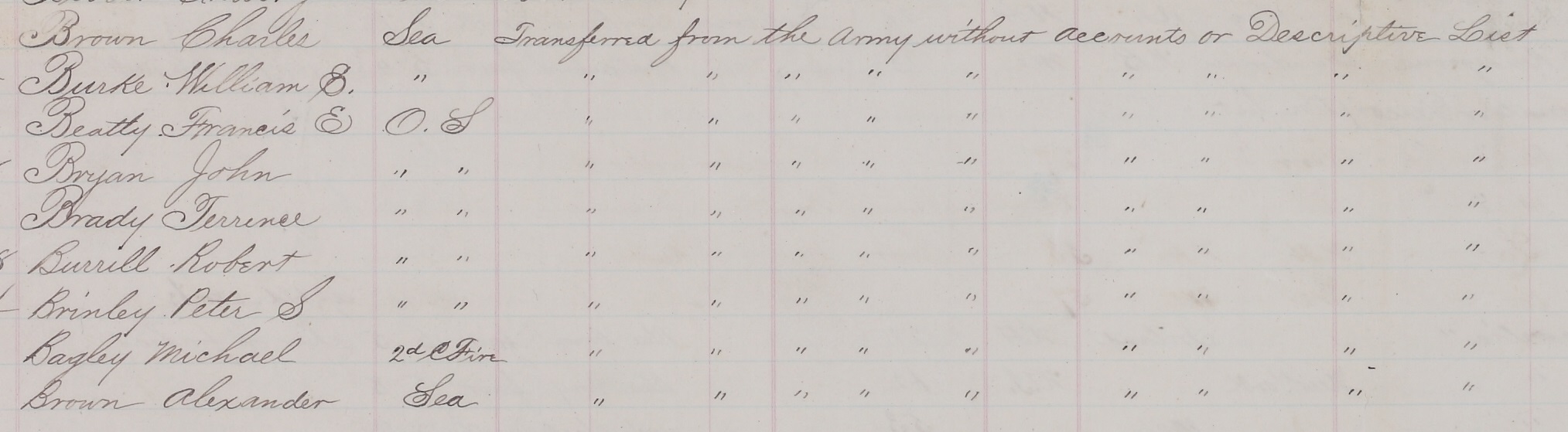
Diving deeper into the sheet that @BlankAJ examined, we can confirm that these men were indeed among those in the army with maritime experience. Close to the top of the men listed in the image above is Francis E. Beatty, who was assigned the rating of Ordinary Seaman. The Census allows us to trace Francis, confirming him a pre-war mariner. In 1860 he was a 16-years-old living in Cedar Creek, Ocean County, New Jersey. There he, his older brother John and his father Samuel (an English immigrant) all followed a life on the water (recorded as “mariners”). But with the coming of war, Francis chose the infantry. He enlisted in what became Company D of the 9th New Jersey Infantry in September 1861, seeing service primarily in North and South Carolina over the years that followed. Francis transferred to the Navy on 3 May 1864. Though he could not have realised it, he could not have picked a more opportune moment to do so, given that his old regiment were about to experience some hard service in Virginia that summer. (3)
These army transfers were not all from the same units. Another of the men on @BlankAJ’s sheet is Peter S. Brinley, who like Francis was rated an Ordinary Seaman. We can also find him in the 1860 Census, which records him as a 26-years-old making his home in Northfield, Richmond County, New York. There he, his three brothers and his father Gilbert were all recorded as “boatmen”. On 12 August 1862 Peter enlisted in Company K of the 132nd New York Infantry as a Corporal- his younger brother John enlisted on the same day. At that time he was recorded as an “Oysterman” (the terms “boatman” and “oysterman” appear largely interchangeable on the 1860 census). The brothers spent most of their army service in North Carolina, At some point in 1863 Peter had been captured by the Confederates, but fortunately was exchanged that October. In February 1864 the Brinley brothers were present when the 132nd experienced its most harrowing action of the war, at the Battle of New Bern, where they sustained more than 90 casualties. They both emerged unscathed, but it may well have been this engagement that prompted them to transfer to the navy- both brothers did so not long afterwards. (4)

Our final example of soldiers in naval service was uncovered by @SandyCycler while working on a 31 March 1863 muster from USS Benton– another ironclad that spent the war on the Mississippi river and her tributaries. Intriguingly, a large number of men on the vessel appeared under the heading “Compagnie F 58th Regiment Ohio Voluntair Infantrie” (see image below). Apart from the highly unusual method of recording American personnel in the French language, what were these soldiers doing on board an ironclad?
It transpires that the 58th Ohio were among a number of units assigned in early 1863 to serve on the Mississippi ironclads, where they performed both guard duties and helped operate the guns. It was an intensive period of activity in this Theater, as U.S. forces sought to capture the city of Vicksburg, Mississippi once and for all. The assistance of these temporary sailors proved invaluable. In February 1863 the commander of USS Mound City, which also had a contingent of 58th Ohio men aboard, wrote admiringly that those on his vessel “conducted themselves like soldiers. They have already acquired a considerable degree of proficiency in the working of the great guns. The only fault I have to find is in the want of uniform dress.” They might not have looked the part, but these Ohio men saw some hard service. In April 1863 the Benton reported on the casualties they sustained when passing the Rebel batteries at Vicksburg, noting that among them was Charles Hillyer of Company F, wounded in the head by a splinter. The 18-year-old farmer is one of the men you can see listed below on the muster @SandyCycler highlighted. (5)

Worse was to come for men of the 58th, when they and the ironclads were engaged with Rebel batteries at Grand Gulf, Mississippi on 29 April 1863. Struck no fewer than 47 times, the Benton suffered 26 casualties, seven of them mortal. Four of the 58th Ohio, men from Companies F and G, were killed, with a further eight wounded. Among the dead was 32-year-old Henry Boshen from Hanover, Germany, the first name to appear in the extracted image below. Another casualty was was Lieutenant Jacob Haring, the 58th Ohio officer who signed off this particular muster entry. His leg had to be amputated at the thigh. Jacob was also a German immigrant, as were many of the officers (and quite a number of men) in the 58th Ohio. It would seem that this European influence may be the reason the record of these men on @SandyCycler’s muster is in a foreign-language, given that many of the senior representatives of the regiment would have been more comfortable with it. The 58th Ohio Infantry stayed with the Mississippi gunboats over the next few weeks, finally returning to more traditional army duties in the aftermath of the Juy 1863 fall of Vicksburg. (6)

The varied discoveries being made by the Civil War Bluejackets Citizen Scientists with respect to army involvement in navy crews demonstrates the value of the work volunteers are carrying out on Zooniverse. Interesting in their own right, the varied examples highlighted by our transcribers come together to provide a much more revealing picture of the whole. They are particularly informative in demonstrating the severe ongoing struggles the Navy had with manpower, and the varied strategies that were employed to try and mitigate them as the war progressed. Needless to say, we are extremely grateful to the dedicated members of our community who brought these examples to light. Be sure to stay tuned for another Bluejackets Community Discovery post in the near future, and remember, if you are interested in coming on board, all you have to do is head over to our Zooniverse Page to get involved!
References
(1) Dennis J. Ringle, Life in Mr. Lincoln’s Navy, 11. (2) Charles Browning Jr., From Cape Charles to Cape Fear: The North Atlantic Blockading Squadron during the Civil War, 201-6. (3) 1860 Census, Civil War Soldiers & Sailors Profiles; (4) 1860 Census, New York Muster Roll Abstracts, 132nd New York Roster; (5) Official Records Series 1, Vol. 24: 435, 556; (6) Official Records Series 1, Vol. 24: 613-4, 1860 Census, Whitelaw Reid Ohio in the War, Volume 2, 351.
 The Civil War Bluejackets Project