

Last week the Civil War Bluejackets team at Northumbria were joined by aspiring historian Madeleine Egner, who came on board for a few days to find out more about the project and to undertake some historical research. Over the course of her short time with us, Madeleine carried out some really valuable work an insightful for Civil War Bluejackets. In this guest post, she outlines for us some of her discoveries when she took a “deep dive” into the lives of one guncrew who worked together to operate a Parrot gun aboard USS Wabash. She shares her fascinating findings below— we think you will agree that Madeleine has a bright future in history ahead!
I am Madeleine Egner, a current A level student in the UK with a passion for history who has had the privilege of contributing to the Civil War Bluejackets research through my week of work experience with Northumbria University. The aim of my work at the beginning of the week was to discover more about a single guncrew on the USS Wabash, so we can begin to investigate the variance in crew not just among the wider ship-board community, but also among specific crew members who interacted directly with one another when operating the gun.
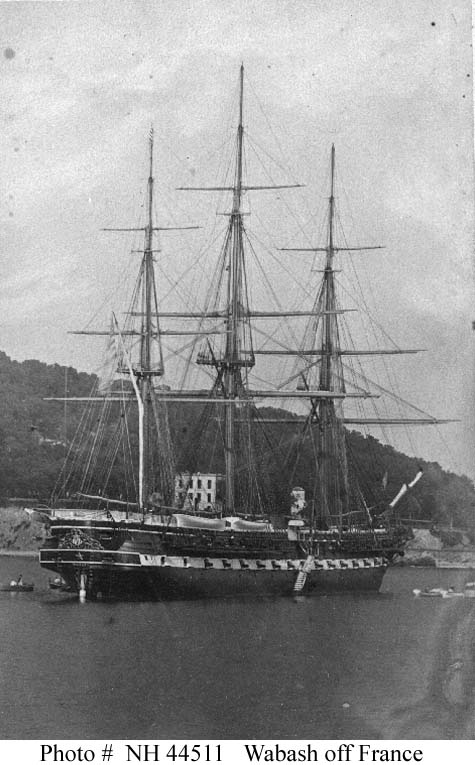
The Wabash was one of the larger vessels serving the United States blockade during the Civil War, and was positioned in the Atlantic where she served (often as a flagship) in both the South Atlantic Blockading Squadron and North Atlantic Blockading Squadron (you can out more about Wabash’s history here). She had been in service before the conflict and she was recommissioned a mere month after the war’s outbreak.

Sailors on USS Wabash with their musical instruments (Photographic History of the Civil War)
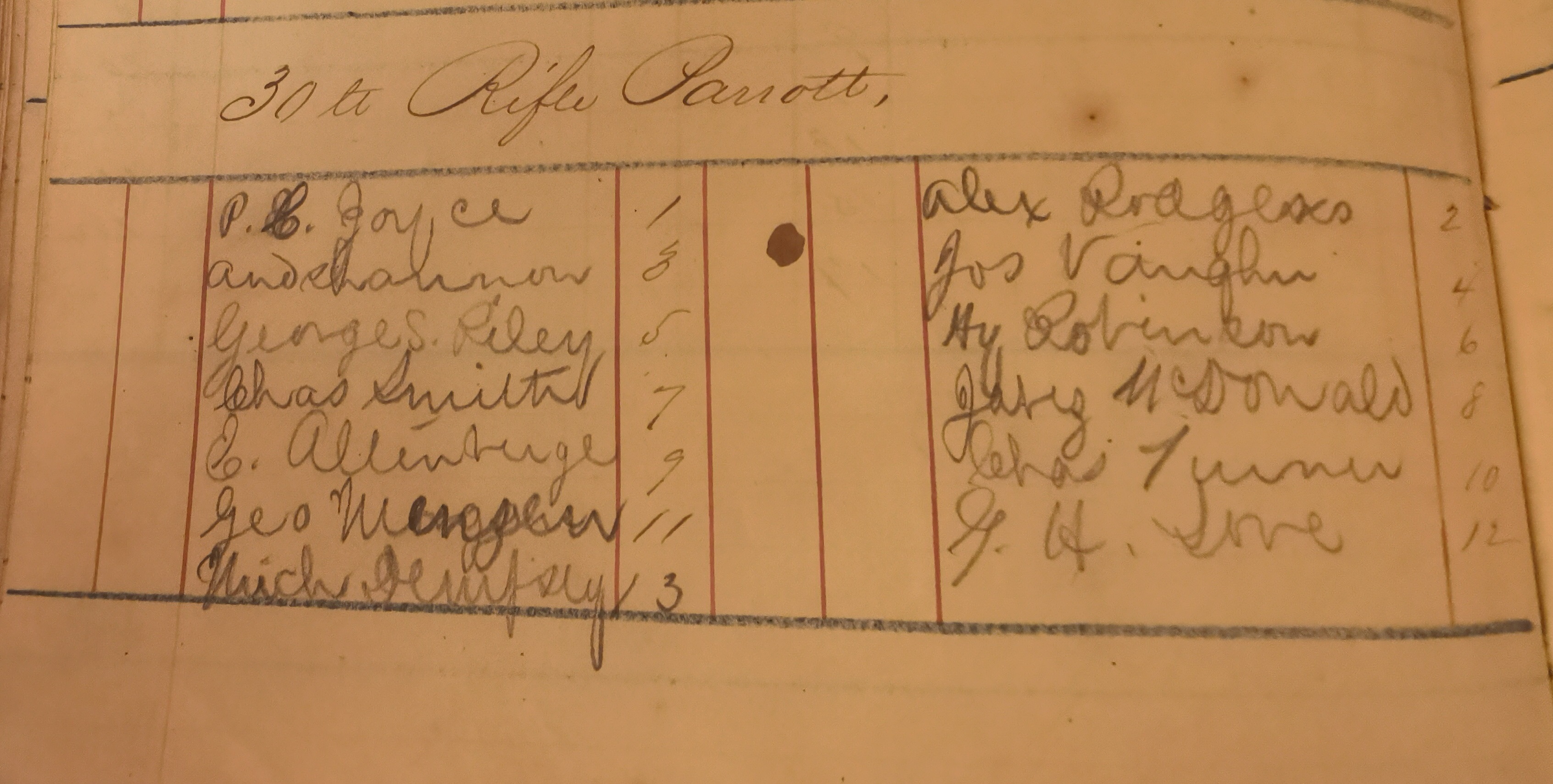
My starting point was the list of names from a single gun crew of the Wabash (below), identified during archival work by the Civil War Bluejackets team at the New York Historical Society, It comes from a manuscript in their collection entitled: US Flagship Wabash “Watch, Station, Fire and Quarter Bill kept by William A. Duer, Acting Master’s Mate”, 1862. Although labelled as originating in 1862, after a day of scouring the 1861-63 muster sheets of the vessel and finding little success in trying to match up the men’s names, we figured something had to be slightly amiss. These suspicions were confirmed when the next day I explored the 1864 muster sheets and identified a total of 9/13 men. It would appear then that the gun crew list we were working was likely a gun crew on the Wabash from c. 1864 rather than 1862.
After overcoming this slight hurdle, the pieces began to come together and I was able to make interesting inferences about the group of men tasked with handling the gun. Of the 9 men I found it is interesting to note that 3 were Irish, 1 was African American, 1 Scottish, 1 Prussian, 1 Canadian, 1 Swedish and 1 was a Dane. Although these men were serving in the United States Navy, only one of them had actually been born in the United States. This vast ethnic diversity among the crew is incredibly enlightening, The presence of the African American sailor on the otherwise all white guncrew is particularly interesting, especially in light of some of the evidence Civil War Bluejackets has identified regarding segregation and discrimination evident on some vessels (for more see e.g. this previous post on the crew of USS Albemarle). The presence of the African American sailor on the Wabash guncrew indicates that the segregation seen on vessels like the Albemarle was not universal practice across all vessels. It also raises questions about what dynamic may have existing been between this diverse set of men. For example Irish-born men, who were in the majority on this crew, came from a community that during this period could harbour unfavourable opinions towards African Americans.
Not only was the ethnic make up of the Wabash’s gun crew fascinating, but so too was the varying degrees of maritime experience the men held. In what was a very close split, 5 men were noted as being ‘Seamen’ and had made their living on the water before enlistment, while 4 were ‘landsmen’- men with no prior naval experience (For more on Seamen and Ordinary Seamen ratings see this post and for more on Landsmen see here). This prompts consideration not just of how gun crews were appointed, but also the process by which men were assigned to specific task on board. Clearly this was likely not on experience alone, and some other factors may have been considered, such as mixing old and new crewmen together. Further research should reveal more about this process.
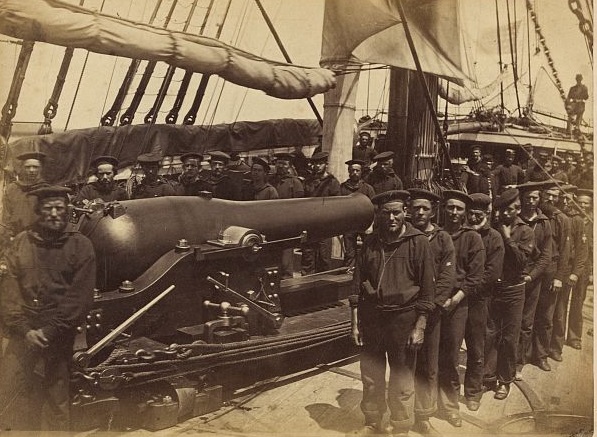
Whilst we have not yet been able to identify all of gun crew members, the 9 we have found through the muster sheets, pension records and other historical sources tell us about the gun crew not just as a unit, but as individuals, an individuality which is important to recognise. Here are some of the details we uncovered:
Guncrew Member Paul Joyce
Paul C. Joyce was an Irishman, and a career mariner— a profession exemplified by a crucifix tattoo on his right forearm which was common among seamen. He served the Navy for 22-years and at the end of the war was hospitalised for “homeostasis.” We uncovered his hospital record, which outlined his condition:
Paul C. Joyce Seaman…29 born in Ireland was admitted on the sick list April 24th 1865 complaining of much pain in left breast. Had been spitting blood for some time a bright red color. Prescribed mild astringents. April 26th sputum darker in color and less in quantity still complaining of much pain and weakness. Applied Capsin to left breast as a counter irritant. Patient has been doing duty as a Boatswain’s Mate. States that he never had above symptoms before. Disease originated in line of duty.
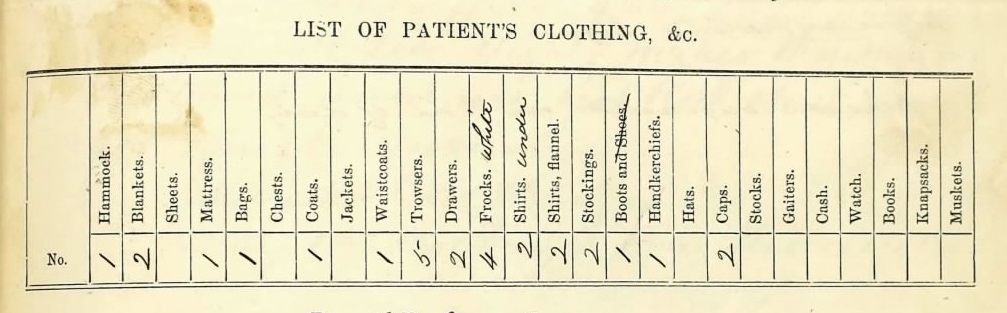
Thankfully Joyce recovered. The fact that the disease was noted to have originated in his service was a detail integral to the success of his later pension claim. In his records (from Norfolk Naval Hospital) we even get a list of the clothing he his possession on his admittance (below) —he seemed to have plenty of trousers!
Guncrew Members Henry Robinson & Alexander Rodgers
Henry Robinson was also a true career seaman, but from Copenhagen, Denmark. His dedication to his occupation was again displayed on his skin, this time with an anchor tattoo on his left hand. Similarly, Scottish sailor Alexander Rodgers, described as a ‘Mariner’, had a crucifix tattoo on his right forearm. The symbolism all three of these men displayed on their bodies shows how important such tattoos were for those who made their life on the sea in the 19th century.
Guncrew Member Charles Turner
Charles Turner is the only African American out of the crew found, signalled by his hair being described in the muster sheets as ‘crispy’ while is skin was variously described as ‘dark’ and ‘black.’ His birthplace of Baltimore, Maryland also suggests that he could have been born into enslavement, as Maryland was a slave state. Charles was rated as a Landsman, a rank in the Navy that African American men were often restricted to during the war, regardless of their previous maritime experience (for more on that, see this post).
Guncrew Members George RIley & Charles Smith
The names George Riley and Charles Smith appear on Wabash muster sheets from both 1861 all the way through 1864, however in each case there appear to be two different men with the same name, as the birthplaces provided do not match. The evidence I have uncovered suggests that it is those from the 1864 sheets who were on the gun crew list, as we believe the list is in actuality from 1864 rather than 1862. These 1864 men are George S. Riley and Charles J. Smith, the latter being from Sweden and the former a Canadian, however both are alike in that they were professional seamen.
Guncrew Members Joseph Vaughn & A.H. Love
Joseph Vaughn was a man of no previous maritime experience, with his pre-war occupation noted as a boiler maker. This was a physically demanding job, as was that of being on a guncrew. He was just 20-years-old, but the hazards of a labouring life were already evident on his body, as he was missing a finger from his left hand. This probably resulted from a workplace accident, but it did not stop him being accepted into the Navy, or being assigned to crew one of the Wabash guns. A.H Love was likewise an unpractised Landsman who came from Prussia, a place of origin which while relatively common in the U.S. army was more unusual in the naval service.
Guncrew Member Michael Dempsey
Of all the men, researching the tumultuous life of guncrew member Micheal Dempsey has to be the pinnacle of my week. He is recorded on the 1864 Wabash records as being 18 and from Ireland. However, this was later brought into question years after his naval service as a gun crew member. Micheal, 52 years after his enlistment applied for his naval pension— from Norristown Prison in Pennsylvania. In his correspondence, he pleaded that the state grant him his pension as he needed the money to pay his fines, or he would remain confined in prison. However, there was further confusion as he was arrested under the name ‘Thomas Eagan,’ an alias he claimed to have used to ‘prevent the disgrace of his ordinary name.’ Upon further investigation the Pension Bureau determined that Micheal/Thomas had actually served 3 prior sentences again under another 3 different aliases- Charles Stevens, Michael Renson and George Watson. Not only were their discrepancies with his name; at the time of his arrest the local paper described him as 45 when he was arrested for drunk and disorderly behaviour. This age is not congruent with his age when enlisting, suggesting he may have about his age or date of birth to one or both of the Navy and authorities.

The information we have gathered may on the surface not seem too groundbreaking, but it allows us to begin to build a picture of shipboard life beyond just figures and statistics, and to consider what interactions at crew level were like especially given their diverse makeup. It invites further questions, such as whether there was any animosity on board between the men of differing ethnicity, or whether their experience of close service together on the gun crew bound them together. It prompts us to consider the methodology used on the Wabash for appointing men to certain crews, and whether or not the other guncrews were similarly diverse. Hopefully, as the Civil War Bluejackets Project continues its research, some of these questions can be explored and answered with reference to both other crews aboard the Wabash and elsewhere across the United States Navy during the American Civil War.
Selected Bibliography
Muster Rolls of USS Wabash, National Archives
U.S. Navy Weekly Enlistment Returns, National Archives
U.S. Navy Survivor’s Pension Certificates, National Archives
U.S. Index to Rendezvous Reports, National Archives
U.S> Naval Hospital Tickets & Case Papers, National Archives
USS Wabash Entry at Naval History & Heritage Command
The Allentown Leader Newspaper
William A. Duer. US Flagship Wabash “Watch, Station, Fire and Quarter Bill kept by William A. Duer, Acting Master’s Mate”, 1862, New York Historical Society
Hidden City: Exploring Philadelphia’s Urban landscape. Historic Norristown Prison Under Imminent Threat of Demolition
 The Civil War Bluejackets Project