
Our last post in the Community Discoveries series told the story of Frank Branch, an African American boy enslaved in Richmond, Virginia who escaped to enlist in the wartime U.S. Navy (you can read it here). The discovery came thanks to our ongoing partnership with the Afro-American Historical and Genealogical Society, who have a team of volunteers making new discoveries relating to African Americans in the muster rolls on a daily basis. Specifically, Frank was identified by community member @GROBSTER- R. Roberts- who has been doing some fantastic transcription work on the project. After the initial post, R. Roberts continued to delve into Frank’s story, specifically seeking to trace what became of Frank’s first and second families. Here they share with us what they uncovered, adding still more detail to what we know of the life and legacy of this boy sailor.
In our original post, we noted that Frank had married fellow Virginia native Luvenia in Springfield, Massachusetts in 1871. By 1880 they were living at Willow Street in the city, with two children- James (5) and Mary (2) recorded. Digging into the Massachusetts records, R. Roberts found that the couple also had an older child, Sarah, who had been born in late 1872. Tragically, Sarah died when she was just five months old, succumbing to congestion of the lungs. We are left to wonder the impact such a tragic death had on Frank and Luvenia.

The birth of the couple’s next child, James, is recorded in the next record. It listed the date as 18th August 1874 and importantly also notes Luvenia’s surname-Watkins- something we had not previously established. It also records Frank’s then occupation, as janitor at a school, marking this as the period when he was working for the School House Department.

The Massachusetts Birth Records provide us with the precise date of the couple’s other daughter, Mary, on 17th May 1877. It also notes that her full name was “Mary Belle”. By this date, Frank’s occupation was being listed as “laborer.”

R. Roberts next when in search of the Branch family on the 1880 Census for Springfield, Massachusetts. It records Frank (noting he has one arm), Luvenia, James and Mary Belle, notes that Frank and Luvenia cannot read or write, and that James was attending school.

As we noted in the original post, Frank and Luvenia’s marriage ended in acrimony. But R. Roberts has gone in search of Luvenia’s fate, and it would appear that she passed away on 22nd January 1888. The record R. Roberts uncovered indicates that Luvenia was just 40-years-old, and died of heart disease. Interestingly the record also names Luvenia’s mother, a woman called Eliza. An additional mention of Luvenia’s death comes in the records of the New York Bodies in Transit, which confirms that Luvenia’s body was taken back to Richmond, her hometown, for burial.

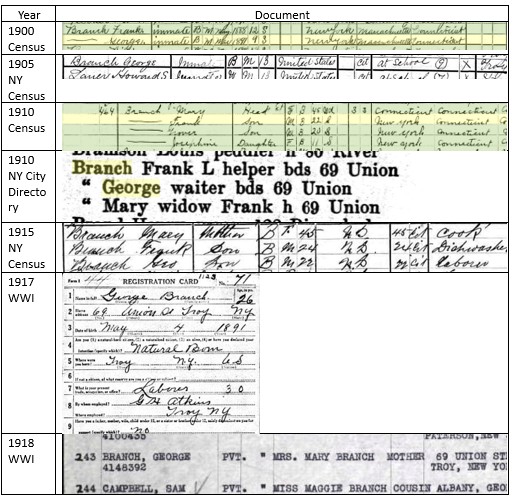
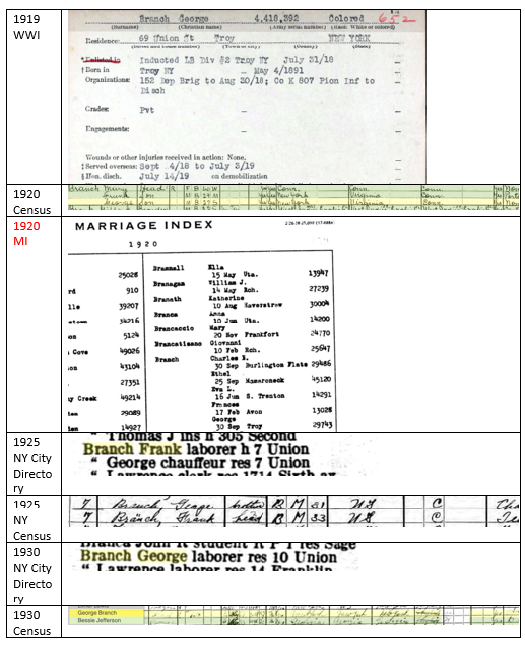
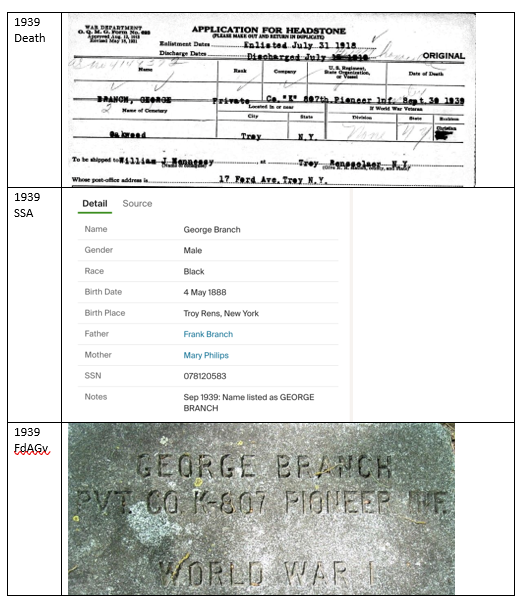
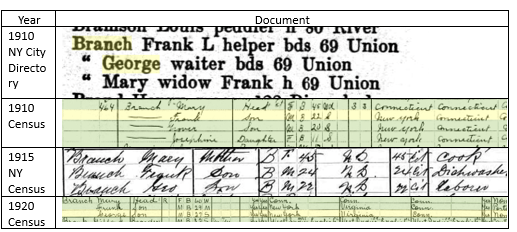
In addition to the fantastic work R. Roberts undertook on the genealogy of Frank’s first family, they also set about constructing a family tree of some of Frank’s children by his second wife. He had married Mary Phillips in the late 1880s, and the new family settled in Troy, New York. Among their children were Frank Jr. (b. 1888), George (b.1891), and Alice (b.1894). R. Roberts has now identified another daughter, Josephine Branch, who was born around 1898. Below are the records R. Roberts has uncovered about the lives of Mary Phillips Branch and her children with Frank- an excellent example of the genealogical work that is possible to trace the families of these Civil War soldiers.
Frank Branch Jr.

George Branch
Mary Phillips Branch
Josephine Branch
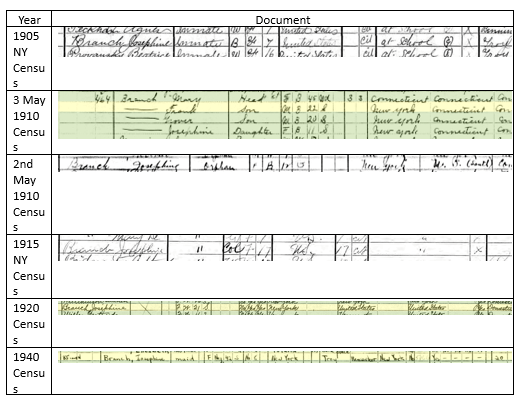
The incredible detail R. Roberts has been able to fill in on the wives and children of Frank Branch are a great example of what we hope will be a major element of the Civil War Bluejackets Project- the recovery of African American genealogies from the pre Civil War era through to the later 20th century. There is undoubtedly more on the Branch family that awaits discovery (and if you come across anything please let us know!), but we now have a much richer picture of his family’s lives and legacies. We are deeply grateful to R. Roberts both for the initial discover of Frank, and for pursuing his family’s story with such dedication.
 The Civil War Bluejackets Project
5 responses to “Bluejacket Community Discoveries: An Update on the Search for Frank Branch, African American Child in the U.S. Navy”
Dr. Shiels– I've just spent nearly an hour trying to log in. All that I wanted to comment upon was to say that it was an excellent piect and shows a lot of work! ~Duncan Ness
Sent: Tuesday, November 14, 2023 at 2:28 AM
LikeLiked by 1 person
Hi Duncan,
I’m sorry you had such trouble logging in! Many thanks for that, I will be sure to pass it on to R. Roberts as well- it really is amazing what we can find out about some of these men and their families thanks to the records that survive!
Kind Regards,
Damian.
LikeLike
[…] [xi] You can read about this research into Frank Branch on our website here https://civilwarbluejackets.com/2023/09/20/bluejacket-community-discoveries-on-the-trail-of-an-african-american-child-in-the-union-navy/ and here https://civilwarbluejackets.com/2023/11/14/bluejacket-community-discoveries-an-update-on-the-search-…. […]
LikeLike
I live in Latham, NY (about 7 miles from Troy). I shared the information that you posted about Civil War Blue Jacket Frank Branch with the Rensselaer County Historical Society to see if they had any records about him and/or his family when they lived in Troy, NY. The houses that they lived in are gone, but I obtained photocopies of the 1929 pictures of the Union Street and what it would have looked like at the time they lived there. People were often getting hit by the trains that ran in that location. Two story brick row houses were built on Union Street after the great fire of 1865. In the late 1960s, many of the buildings were razed for urban renewal.
An elderly woman who volunteers at the Historical Society said that she taught some African American Branches in the past. She suggested that I check the Black churches in Troy to see if anyone knows if any of them are still in the area. There is an organization in Troy called the Troy Area United Ministry (TAUM), 392 2nd St, Troy, NY 12180, 518-274-5920, https://taum.org
If you want the three photo copies of the photos of the street they lived on, send me an email address to send them to. I inquired about the Hudson Navigation Company, but they had no information about it. I will check the NYS Library for information. Rensselaer County Historical Society is really excited to hear about this research and would love to learn to have you keep them abreast of developments. They said they might consider doing an exhibit when you have completed your research.
If there is any on the ground leads that I can help you with, please feel free to contact me.
LikeLike
I just found a photo of a boat that was used for the Hudson Navigation Company (if you want the photo, send me an email) that George Branch worked as a porter on. The Hudson Navigation Company Citizens Line traveled between Troy and New York. The Hudson River Maritime Museum at 50 Rondout Landing, Kingston, NY ( 845-338-0071 ; https://www.hrmm.org) may have more information about the Hudson Navigation Company and its employees. On Broadway, in Albany, new Hudson Navigation docks and sheds were completed in 1918 at Steamboat Square. Troy is only 7-10 miles from downtown Albany, so George Branch could have worked out of Troy or Albany. I have yet to find where the Hudson Navigation Co boats would have docked in Troy at that time. I found a 1919 ad for the Hudson Navigation Company’s Hudson River night service, New York, Albany, and Troy: “The Searchlight Route”. It is described as the largest and most luxurious river steamers in the world, and shown with the searchlight in use. The following is a link for a YouTube video of some of the boats that traveled up and down the Hudson from Troy to NYC in the early 1900s that were Hudson Navigation Co. boats: https://youtu.be/rmK8HrCtg6k?si=b1ubHTjA-BnCBpni
LikeLike